Many functions are defined as the concatenation - the linking together of things, like in a chain - of other functions. Checking for continuity of such concatenated functions by using the classical epsilon-delta criterion for continuity is often tedious. However, one can prove that the concatenation of continuous functions is once again a continuous function. This is an important tool that simplifies the proof for continuity of compositions of functions.
Concatenation Theorems [Bearbeiten]
The concatenation theorems for continuous functions are the following:
Motivation [Bearbeiten]
Imagine, we are given a function containing sums, products and quotients like  ,
,  . We would like to know whether this function is continuous at some argument
  . So we consider any sequence of arguments
  converging to
  and check whether there is always
 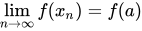 . For handling sums, products and quotients, the limit theorems for convergent sequences turn out to be very useful:
![{\displaystyle {\begin{aligned}\lim _{n\to \infty }f(x_{n})&=\lim _{n\rightarrow \infty }{\left|{\frac {1+x_{n}^{3}}{1+x_{n}^{2}}}\right|}\\[0.5em]&\quad {\color {Gray}\left\downarrow \ {\text{rule for absolute values}}\right.}\\[0.5em]&=\left|\lim _{n\to \infty }{\left({\frac {1+x_{n}^{3}}{1+x_{n}^{2}}}\right)}\right|\\[0.5em]&\quad {\color {Gray}\left\downarrow \ {\text{quotient, product and sum rule}}\right.}\\[0.5em]&=\left|{\frac {\lim _{n\to \infty }1+\left(\lim _{n\to \infty }x_{n}\right)^{3}}{\lim _{n\to \infty }1+\left(\lim _{n\to \infty }x_{n}\right)^{2}}}\right|\\[0.5em]&\quad {\color {Gray}\left\downarrow \ \lim _{n\to \infty }x_{n}=a\right.}\\[0.5em]&=\left|{\frac {1+a^{3}}{1+a^{2}}}\right|=f(a)\end{aligned}}}](https://wikimedia.org/api/rest_v1/media/math/render/svg/cf305dc74e13623642d5cb59920c2d671172c3ef)
Those formulas could be applied because all subsequences converge (we showed this in the end of our calculations). As was chosen to be arbitrary, we directly obtain the continuity of the entire function  . This proof of continuity is basically an application of the sequence criterion plus theorems for sequence limits. Since, thanks to the limit theorems, the limit can be pulled into the function, we can use it to establish continuity. And the above concatenation theorems shorten proofs of this kind even further. we consider the following functions:
Now, may be written as a concatenation of those three functions:

As all three functions ,  and
and  are continuous, the concatenation theorems will directly imply continuity for . This argumentation is even shorter than the proof using the sequence criterion. So the continuity proof can be concluded in one sentence: is continuous because it is a concatenation of continuous functions. And indeed, any concatenation constructed out of continuous functions (i.e. by combining polynomials) is continuous.
Problem Example [Bearbeiten]
The following problem illustrates just how easy it is to establish continuity of a function using the concatenation theorems:
Exercise (Continuity of a concatenated square root function)
Prove continuity for the following function:

How to get to the proof? (Continuity of a concatenated square root function)
The above function is just a concatenation of several simple functions, serving as building blocks. Our main task is to find those building blocks. They are given by:
This allows writing as a concatenation:

So is simply continuous because it is a concatenation of continuous functions.
Proof (Continuity of a concatenated square root function)
Let the following functions be given:
These functions are continuous. Further, we can write  . Hence, is a concatenation of continuous functions, so it is continuous, as well.
General sketch of the proof [Bearbeiten]
Following the concatenation theorems, every composition of continuous functions is again continuous function. So if  can be written as a concatenation of continuous functions, we can directly infer continuity of . A corresponding proof could be of the following form:
In a lecture, this proof scheme may of course only be applied if the concatenation theorems have already been treated before. In any way, it is a very efficient method to characterize continuous functions.
Corollary: Polynomial functions are continuous [Bearbeiten]
Every polynomial function can be written as a concatenation of following the two functions:
is the identity  the constant function with value . These functions are continuous and hence, every polynomial function is continuous. For instance, we may construct the polynomial function
  out of and as follows:

Explicitly, this decomposition reads:

Further examples [Bearbeiten]
Exactly as subsequences have to converge for a concatenation sequence to converge, we need that our building brick functions are continuous in order to obtain a continuous concatenation function. When using non-continuous functions for the concatenation, we do not know anything about the continuity of the outcome. For instance:
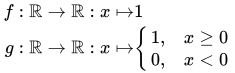
The function is continuous at  , whereas
  is not. The product of both functions is again , since
  . Therefore the product (i.e. a concatenation) is discontinuous at . By contrast to what one may intuitively expect, concatenating discontinuous functions may also yield us a continuous function. To illustrate this, let us consider:

This function maps rational numbers to  an all other to
  . Concatenating
  with itself, we get the following function
  :
:
![{\displaystyle {\begin{aligned}h(h(x))&={\begin{cases}0,&h(x)\in \mathbb {R} \setminus \mathbb {Q} \\1,&h(x)\in \mathbb {Q} \end{cases}}\\[0.3em]&\quad {\color {Gray}\left\downarrow \ h(x){\text{ is always rational.}}\right.}\\[0.3em]&=1\end{aligned}}}](https://wikimedia.org/api/rest_v1/media/math/render/svg/f00ad53d4bb093a4aa0ce9c64a9902364cac7b74)
is just a constant function. Hence it is continuous - although was actually nowhere continuous. So concatenating discontinuous functions may indeed yield us a continuous function.
Proof of concatenation theorems [Bearbeiten]
Continuity under addition [Bearbeiten]
Proof (Concatenation theorem for sums)
We will prove the addition rule for continuity by checking the sequence criterion. Let be any sequence of arguments taken from the domain  and converging to . There is:
![{\displaystyle {\begin{aligned}&\lim _{n\to \infty }(f+g)(x_{n})\\[0.3em]=&\lim _{n\to \infty }\left(f(x_{n})+g(x_{n})\right)\\[0.3em]&\quad {\color {Gray}\left\downarrow \ {\text{Limit theorem: addition rule}}\right.}\\[0.3em]=&\lim _{n\to \infty }f(x_{n})+\lim _{n\to \infty }g(x_{n})\\[0.3em]=&f(a)+g(a)=(f+g)(a)\end{aligned}}}](https://wikimedia.org/api/rest_v1/media/math/render/svg/8729f37d592afd59f9c73ca77b82dead4de5cc9f)
Alternative proof (Concatenation theorem for sums)
It is also possible to establish continuity of  in by checkng the Epsilon-Delta criterion . Let any
  be given. As is continuous at , there has to be a
  , such that for all
  with
with  the inequality
  holds. Analogously for , there is a
  , such that for all with
  the inequality
  holds.
Now, we set  . Hence, for all with
  ,both the conditions and are fulfilled. Thus, for all
  with , there is:
![{\displaystyle {\begin{aligned}&|(f+g)(x)-(f+g)(a)|\\[0.3em]&\quad {\color {Gray}\left\downarrow \ {\text{definition of the function }}(f+g)\right.}\\[0.3em]&=|f(x)+g(x)-(f(a)+g(a))|\\[0.3em]&\quad {\color {Gray}\left\downarrow \ {\text{associativity of }}\mathbb {R} \right.}\\[0.3em]&=|(f(x)-f(a))+(g(a)-g(x))|\\[0.3em]&\quad {\color {Gray}\left\downarrow \ {\text{triangle inequality}}\right.}\\[0.3em]&\leq \underbrace {|f(x)-f(a)|} _{\color {Gray}<\epsilon /2{\text{, da }}|x-a|<\delta \leq \delta _{f}}+\underbrace {|g(a)-g(x)|} _{\color {Gray}<\epsilon /2{\text{, da }}|x-a|<\delta \leq \delta _{g}}\\[0.3em]&<\epsilon /2+\epsilon /2=\epsilon \end{aligned}}}](https://wikimedia.org/api/rest_v1/media/math/render/svg/4d7d1f3c0934d9c60d33f25c52b577ce0007b813)
Continuity of scalar multiplication [Bearbeiten]
Continuity under multiplication [Bearbeiten]
Continuity of quotients [Bearbeiten]
Continuity of compositions [Bearbeiten]
Comparison with the epsilon-delta criterion [Bearbeiten]
In the beginning of this article, we used the concatenation theorems in order to show that the function  is continuous. We will no perform a second proof "by hand", using the epsilon-delta criterion. The proof will cost us more work, but we will get an explicit information on the maximal initial error
  we have to choose, in order to stay below a given threshold for the error of the outcome.
Exercise (Epsilon-Delta proof for the continuity of the Square Root Function)
Show, using the epsilon-delta criterion, that the following function is continuous:

How to get to the proof? (Epsilon-Delta proof for the continuity of the Square Root Function)
We need to show, that for any given , there is a  , such that all
  with satisfy the inequality
  . So let us take a look at the target inequality and estimate the absolute
 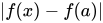 from above. We are able to control the term
  . Therefor, would like to get an upper bound for including the expression . So we are looking for an inequality of the form

Here,  is some expression depending on and . The second factor is smaller than and can be made arbitrarily small by a suitable choice of . Such a bound is constructed as follows:
![{\displaystyle {\begin{aligned}|f(x)-f(a)|&=\left|{\sqrt {5+x^{2}}}-{\sqrt {5+a^{2}}}\right|\\[0.3em]&\quad {\color {Gray}\left\downarrow \ {\text{expand with}}\left|{\sqrt {5+x^{2}}}+{\sqrt {5+a^{2}}}\right|\right.}\\[0.3em]&={\frac {\left|{\sqrt {5+x^{2}}}-{\sqrt {5+a^{2}}}\right|\cdot \left|{\sqrt {5+x^{2}}}+{\sqrt {5+a^{2}}}\right|}{\left|{\sqrt {5+x^{2}}}+{\sqrt {5+a^{2}}}\right|}}\\[0.3em]&\quad {\color {Gray}\left\downarrow \ {\sqrt {5+x^{2}}}+{\sqrt {5+a^{2}}}\geq 0\right.}\\[0.3em]&={\frac {\left|x^{2}-a^{2}\right|}{{\sqrt {5+x^{2}}}+{\sqrt {5+a^{2}}}}}\\[0.3em]&={\frac {\left|x+a\right|}{{\sqrt {5+x^{2}}}+{\sqrt {5+a^{2}}}}}\cdot |x-a|\\[0.3em]&\quad {\color {Gray}\left\downarrow \ K(x,a):={\frac {\left|x+a\right|}{{\sqrt {5+x^{2}}}+{\sqrt {5+a^{2}}}}}\right.}\\[0.3em]&=K(x,a)\cdot |x-a|\end{aligned}}}](https://wikimedia.org/api/rest_v1/media/math/render/svg/7fd151e0f901ce664e4e622e2ead380c1b77aa08)
Since , there is:

If we now choose small enough, such that 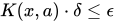 , then we obtain our target inequality
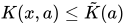
  . But still depends on , so would have to depend on , too - and we required one choice of which is suitable for all . THerefore, we need to get rid of the -dependence. This is done by an estimate of the first factor, such that our inequality takes the form
  :
:
![{\displaystyle {\begin{aligned}K(x,a)&={\frac {\left|x+a\right|}{{\sqrt {5+x^{2}}}+{\sqrt {5+a^{2}}}}}\\[0.3em]&\quad {\color {Gray}\left\downarrow \ {\text{triangle inequality}}\right.}\\[0.3em]&\leq {\frac {\left|x\right|}{{\sqrt {5+x^{2}}}+{\sqrt {5+a^{2}}}}}+{\frac {\left|a\right|}{{\sqrt {5+x^{2}}}+{\sqrt {5+a^{2}}}}}\\[0.3em]&\quad {\color {Gray}\left\downarrow \ {\frac {a}{b+c}}\leq {\frac {a}{b}}{\text{ for }}a,c\geq 0,b>0\right.}\\[0.3em]&\leq {\frac {\left|x\right|}{\sqrt {5+x^{2}}}}+{\frac {\left|a\right|}{\sqrt {5+a^{2}}}}\\[0.3em]&\quad {\color {Gray}\left\downarrow \ {\frac {|a|}{\sqrt {5+a^{2}}}}\leq 1{\text{, since }}{\sqrt {5+a^{2}}}\geq {\sqrt {a^{2}}}=|a|\right.}\\[0.3em]&\leq 2=:{\tilde {K}}(a)\end{aligned}}}](https://wikimedia.org/api/rest_v1/media/math/render/svg/fb1a15225e7caed47a4e11e56b9343fcbf2c6960)
We even made  independent of , which would in fact not have been necessary. So we obtain the following inequality

We need the estimate  , in order to fulfill the target inequality . The choice of
  is sufficient for that. So let us write down the proof:
Post a Comment for "N Composition of Continuous Function is Continuous"