Facebook Blocks Festive Image of Santa Claus Kneeling Before Baby Jesus
For the second time in your life, y'all're going to need to forget everything yous recollect you know about Santa Claus.
While the commencement big revelation all those years agone may accept been fraught with thwarting, the true history of how the big, jolly man in the blood-red suit came to be is completely fascinating and filled with the quirky enchantment we've come to expect from Christmas.
In the story we're nearly to tell you, the fable of Santa spans multiple continents, assumes many different identities, gets hijacked past first settlers in colonial America, takes a trip through the Civil State of war, and gets a makeover from a New York advertising firm - thanks to the best known soft drink in the world.
Let'due south start at the beginning
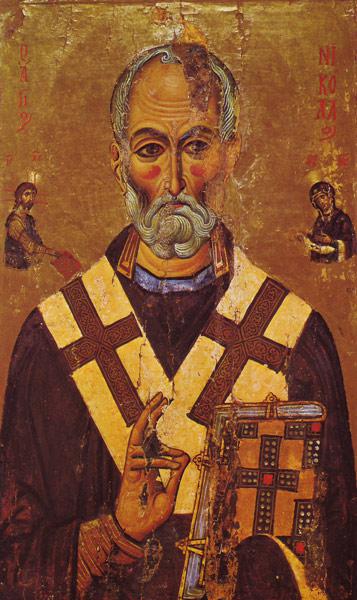
If you were to ask people where the legend of Santa Claus began, they'd probably commencement by telling you that the name "Santa" is simply a moniker for Saint Nicholas, a human who existed a long fourth dimension ago and was renowned for his generosity toward children.
We hear nearly Saint Nick in carols like Rudolph the Red Nosed Reindeer, and stories like The Night Before Christmas, but beyond that the homo remains a bit of a mystery.
Past all accounts, his story begins in the quaternary century Ad in what is now modern-solar day Turkey. A human being named Nicholas became the bishop of a village called Myra. He was subsequently canonised, and soon became ane of the most popular saints in Christianity.
That'south near all we know for sure only much of the sociology surrounding Saint Nick speaks of his kindness and generosity toward children, in a world where those attitudes weren't easy to discover.
Despite being the patron saint of many European countries including Russian federation, Austria, Kingdom of belgium, France and Frg, information technology was in kingdom of the netherlands where nosotros first began to see some semblance of the Santa Claus nosotros're familiar with today.
Each year, the much-loved saint was honoured during the Feast of Saint Nicholas (or Sint-Nikolaas), where parents would leave gifts out for their children, who naturally believed Saint Nicholas had paid them a visit during the night.
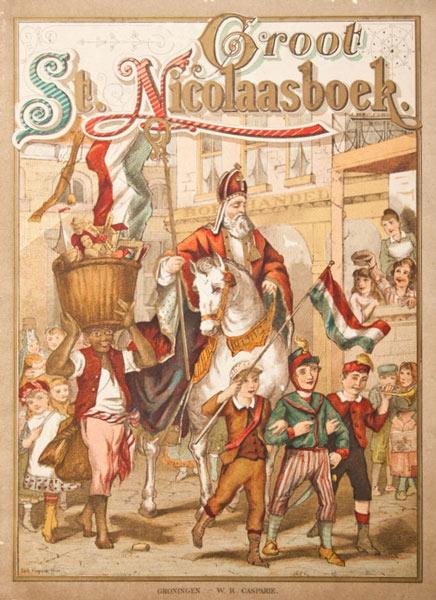
Different the modern depictions of Santa, the Dutch version of Saint Nick rode on a donkey and wore a alpine pointy bishop'south hat.
In the same way kids today leave out a glass of milk with some cookies for Santa and his reindeer, Dutch children would make full their clogs with straw and leave them out for the donkey to eat.
When they woke the side by side morn, they'd find the harbinger gone and their shoes packed with presents.
Santa'south motion to America
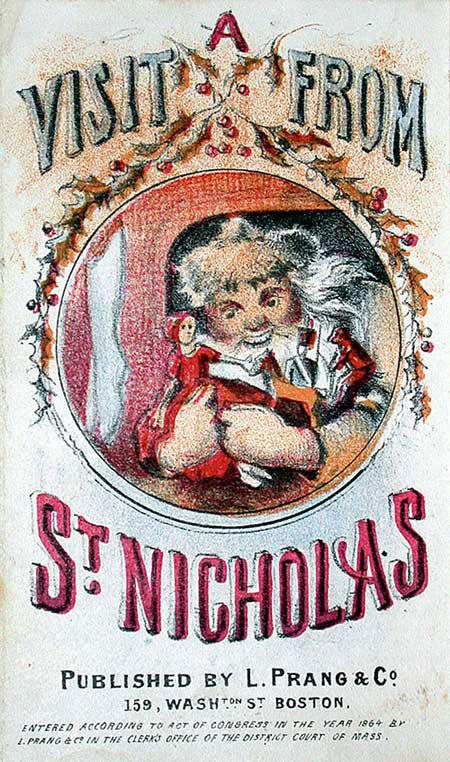
Like most myths, the story of Saint Nicholas evolved and became embellished over the years and - given their fondness for him - it'south hardly surprising to learn that in 1664, the legend of Saint Nicholas travelled across the Atlantic to Dutch colony of New Amsterdam; or as it'south known today, New York Metropolis.
In the 200 years that followed, and equally a means of preserving their culture and traditions in the face of British settlement, a group of Dutch intellectuals gathered together and called themselves the "Knickerbockers."
A prominent fellow member of the group was a writer named Washington Irving, who published a book called The Knickerbocker's History of New York, containing satirical versions of Dutch traditions and stories.
Throughout the volume in that location were several dozen references to a "Sinter Klaas" - an adaptation of "Sint Nikolaas" - accompanied by details of him flying across the sky in a railroad vehicle and dropped presents downwardly chimneys for good little girls and boys.
Washington'south wild, endearing description of the saint very quickly became known to New Yorkers. The English settlers enthusiastically adopted the blithesome Dutch celebrations of St. Nicholas' Twenty-four hour period, and gradually began to combine them with their own traditions of celebrating Christmas and the new year's day.
When it comes to pronunciation, it's easy to see how "Sinter Klaas" could translate to "Santa Claus" when y'all use the accent of an English-speaking New Yorker.
Clement Clarke Moore and the Night Before Christmas
Clement Clarke Moore was a friend of Washington Irving, and another important contributor to the moving-picture show of Santa we have today.
Teresa Chris, writer of the bookThe Story of Santa Claus, wrote that in 1822, Moore saturday downwardly to write his children a Christmas verse form, having been inspired by Irving'southward tales.
Clement's poem, originally titledA Visit from St. Nicholas, soon became known equally the classicThe Nighttime Before Christmasand was so popular that inside a decade it had become canon with regard to the Santa fable.
When writing the poem, Teresa said Clement fabricated a few alterations to the Sinter Klaas legend to make the story more relatable to people from a British/Anglo background, and information technology'south interesting to note how his alterations still manifest in the Santa mythology of today.
"The clogs the Dutch children left by the chimney corner on December 6 became something all children could chronicle to in cold weather - stockings, and the wagon became a "miniature sleigh" pulled by "eight tiny reindeer," Teresa wrote in her book.
The equus caballus drawn sleigh with its bells was a common ways of transport for the English, and substituting horses with reindeer added an chemical element of mystery to Saint Nick, every bit though he was from an ice-capped Northern country, where few people had traveled, somewhere secluded from the world.
It's believed that Clement never intended for anyone other than his family to hearA Visit From St. Nicholas. He allegedly even refused to admit he was the author. Despite his objections, the poem wound upward printed anonymously in theNew York Lookout on December 23, 1823. Some say it was thanks to Clement's wife Catharine Taylor who liked the story then much that she sent copies to her friends.
The mythology connecting Santa with the Christmas period had been well and truly established past this phase, but there was even so some discrepancy around what exactly Santa looked like.
Thomas Nast and the American Civil War
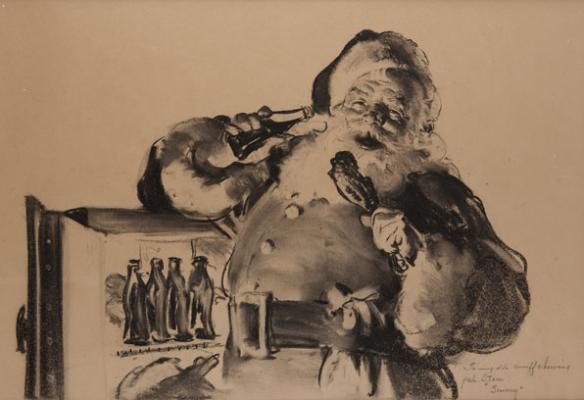
In the mid-1800s, it was popular to describe Santa Claus either in his bishop's robes or as a man with a pointed hat, long coat, and directly bristles. It wasn't uncommon to see Santa drawn every bit quite tall and gaunt.
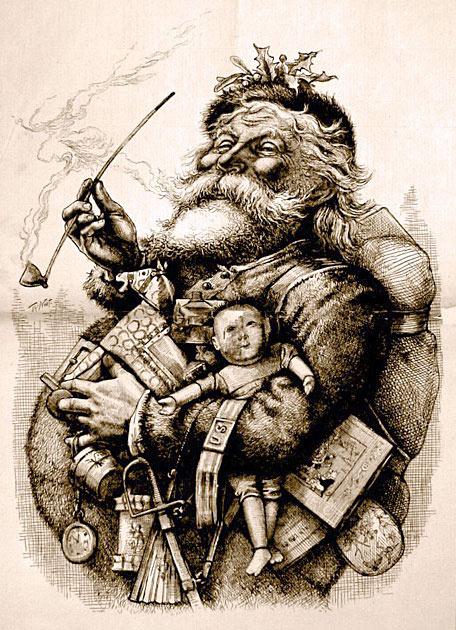
This changed in 1863, whenHarper'southward Weeklyhired a 21-year-old named Thomas Nast to depict a flick of Santa Claus bringing gifts to troops fighting in the American Civil War.
The Santa that Thomas drew combined Clement's clarification of Saint Nicholas fromThe Night Earlier Christmas with the all too familiar propaganda image of Uncle Sam.
Nast's Santa was a jolly, roly-poly old man who wore a star-spangled jacket, striped pants, and a cap.
"The drawing boosted the spirits of soldiers and civilians alike considering it showed that the spirit of Christmas had come to the Civil War," wrote historian James I. Robertson.
It was so pop, that every year, for 40 years, when the magazine asked Nast to draw Santas, he stuck with the same concept - although he did eventually driblet the stars and stripes in favor of a plain wool adapt.
Although this woolen suit was sometime green, Nast popularised Saint Nick's famous scarlet clothes, more than 4 decades prior to The Coca-Cola Company'south depiction of Santa - opposite to the rumour that "Coca-Cola made Santa blood-red".
The History of Coca-Cola and Santa Claus
If the American Santa Claus took shape by repetition, then it's fair to say that Coca-Cola led the charge through much of the 20th century - although information technology would exist unfair to say Coca-Cola invented Santa.
The company'due south relationship with Santa began in the 1920s, when Coca-Colafirst began advertising in American magazines similarThe Sat Evening Postduring the festive season.
The ads used images of a man dressed as Santa, not unlike in advent to the Santa Claus in Thomas Nast's delineation from the mid-1800s. This Santa was usually depicted outside the globe's largest soda fountain or visiting high profile department stores, and things stayed that style up until the 1930s.
Christmas advertizing had get a powerful part of Coca-Cola's business organization operations. In 1931 the company deputed the services of D'Arcy Advertising Bureau and Michigan-born creative person Haddon Sundblom to create a campaign featuring a more than wholesome and approachable Santa Claus - something that captured the truthful essence of Santa himself, and wasn't merely a man dressed up in a costume.
For his inspiration, Haddon turned to Clement'southwardThe Dark Earlier Christmas. The description of Santa as a "jolly erstwhile elf" dressed in red furs who goes downward chimneys to give children their gifts was instrumental in laying the foundations for our image of modern Santa Claus.
The poem described Santa as a dwarfish "jolly old elf," dressed in cherry furs who goes downward chimneys to requite children their gifts. Cloudless'south account was and so brilliant and compelling that it became the standard.
In the early days Haddon called upon his friend, retired salesman Lou Prentiss, to human activity as a live model on which he based his images. When Lou passed away Sundblom used himself as a model and painted while looking into a mirror.
From 1931 to 1964, Coca-Cola advertising showed Santa delivering toys (and playing with them!), pausing to read a letter of the alphabet and enjoy a Coke, visiting with the children who stayed upwards to greet him and raiding the refrigerators at a number of homes.
Haddon's Santa appeared regularly inThe Saturday Evening Post as well as inLadies Dwelling house Journal, National Geographic, The New Yorker and more.
People paid such close attention to the Coca-Cola Santa images that when anything changed they sent letters to The Coca-Cola Company. One yr, Santa'southward large chugalug was backwards (perhaps considering Haddon was painting via a mirror). Another year Santa Claus appeared without a hymeneals ring causing fans to write asking what happened to Mrs Claus.
Haddon created his concluding version of Santa Claus in 1964 but for several decades to follow Coca-Cola advertisement featured images of Santa based on Haddon's original works.
Santa today
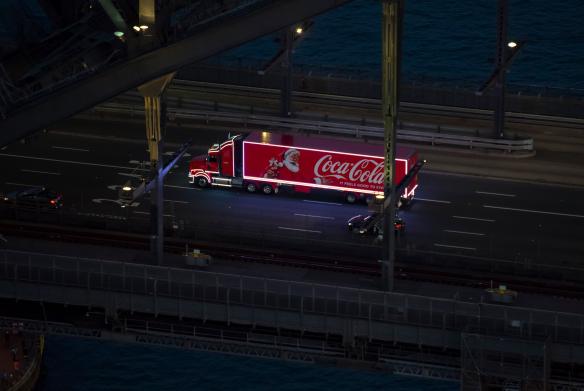
At that place has been trivial change to the popular representation of Santa Claus since the 1960s. Certain, he may wear board shorts on Aussie Christmas cards but he still rocks a beard. On the side of the Coca-Cola Christmas trucks in Australia he'southward notwithstanding glowing with his shiny cheeks and twinkly eyes.
These days Santa can be emailed directly and tracked online every bit he flies through the sky. It's likely he and Mrs Claus run the globe'southward best supply chain and his elves have Hollywood condition.
Just nosotros'll withal leave the reindeers a carrot on Christmas eve (Australia), put our shoes out (the netherlands) or get out him rice porridge with cinnamon sugar (Kingdom of denmark). Great stories volition always have a life of their ain.
Facebook Blocks Festive Image of Santa Claus Kneeling Before Baby Jesus
Source: https://www.coca-colacompany.com/au/news/definitive-history-of-santa-claus

Post a Comment for "Facebook Blocks Festive Image of Santa Claus Kneeling Before Baby Jesus"